
Money Leaks in Australia – How Couples Can Spend Smarter
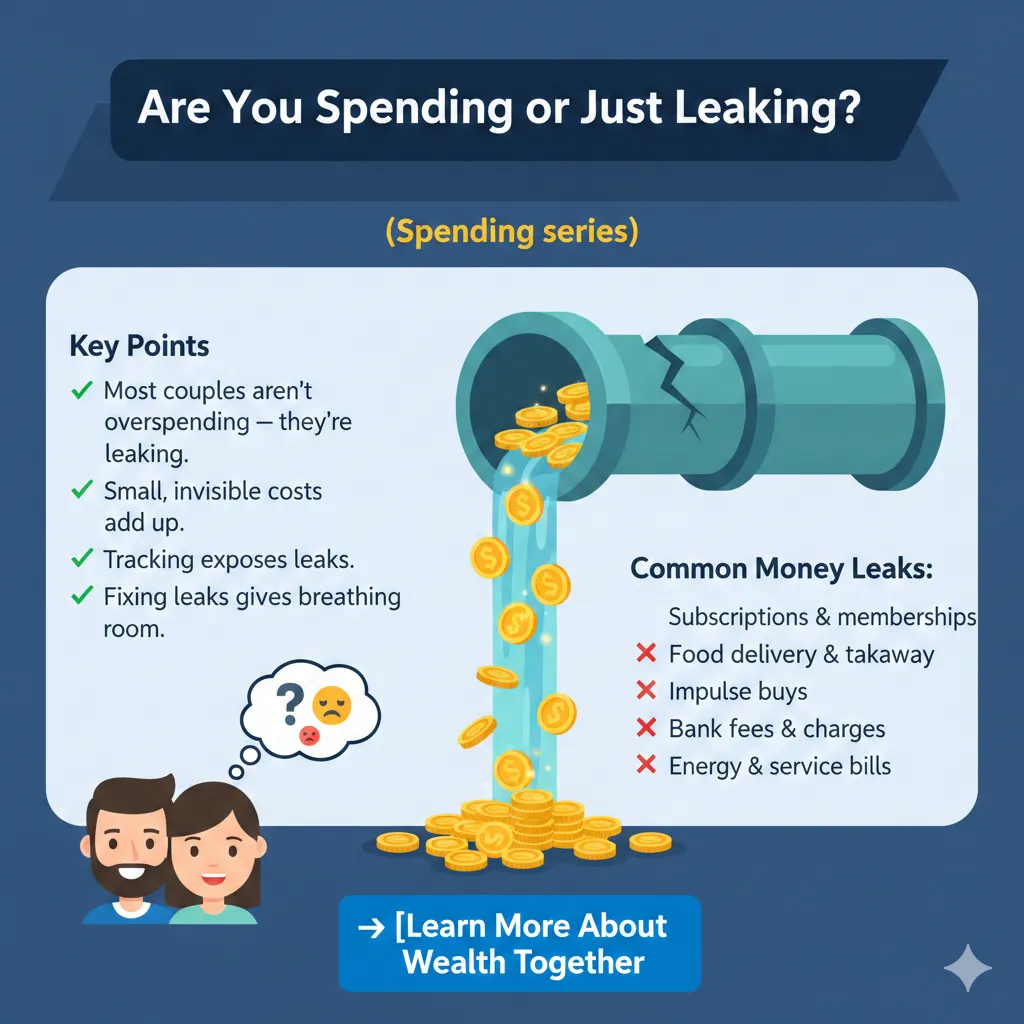
Are You Spending or Just Leaking?
(Spending series)
Key Points (Quick Scan)
Most couples aren’t overspending — they’re leaking money without realising.
Small, invisible costs add up to hundreds each month.
Tracking, even for 7 days, exposes the leaks instantly.
Fixing leaks gives breathing room without cutting joy.
Why It Feels Like You’re Always Broke
Many Aussie couples feel like they’re careful with money — but still end each month wondering, where did it all go?
The truth? It’s not usually “big spending” that sinks you. It’s small, unnoticed leaks: subscriptions, food delivery, impulse buys. When you add them up, they quietly drain your cashflow.
As Dave The Money Dad, I see this all the time. Couples swear they don’t overspend — and they don’t, on purpose. But without tracking, the leaks keep flowing.
A Couple’s Story: The 7-Day Wake-Up Call
One couple thought they had no room to save. They agreed to track every dollar for 7 days. The result? Over $216 in “unneseccary” spending on a $49 / month subscription, and saved $112 / month moving from individual mobile phone plans to a family plan ($207 to $95), $55 / month on one less takeaway
They weren’t extravagant — just unaware. Once they saw the leaks, they plugged them with small tweaks. Within a month, they had an extra $200 heading into savings.
Common Money Leaks in Aussie Households
Subscriptions & memberships (streaming, apps, gyms)
Food delivery & takeaway (those $30 orders add up fast)
Impulse buys (online shopping, late-night scrolls)
Bank fees & chargesn & returns (avoidable with smarter accounts)
Energy & service bills (Loyality Tax - not shopping around for better rates)
💡 Tip: You don’t need to cut everything — just be intentional about what stays.
How to Spot and Stop Leaks
Track for 7 days. Write down every dollar — awareness is step one.
Check your bank statements. Look for unexpected or surprising entries
Highlight “forgotten” spends. These are your leaks.
Decide: cut, swap, or keep. Cut what doesn’t matter, swap for cheaper options, and keep what brings joy.
Redirect savings. Move the freed-up dollars to your Uplift bucket (savings/investing).
Why Couples Should Do This Together
No more finger-pointing. You’re both looking at facts, not feelings.
Shared wins. Spotting $200 in leaks feels like finding free money.
More calm. Less blame, more teamwork.
Internal Links for Next Steps
Ready to Plug the Leaks?
You don’t need to spend less — you just need to spend smarter. Awareness turns leaks into breathing room, without sacrificing joy.
Ready to Finally Feel on Top of Your Finances?
You don’t have to do it alone.
Your past shapes you, but it doesn’t define your future. By understanding your money stories, you and your partner can create a shared script that brings calm and confidence.
Building this habit is the first step to turning your 'Safety' light Green. I built the DTMD Financial Scorecard to show you exactly where you stand. It doesn't just track your numbers; it tracks your momentum.
Don't just read about automation—see it working. DTMD Financial Scorecard here - It is FREE to use
Built for real life, not spreadsheets
Super easy to use
Buffers, budgeting, debt help and more
FAQ: Spending vs. Leaking
Q: How do we know if it’s a leak or a value spend?
A: If it adds real joy or supports your goals, it’s spending. If you don’t notice it, don’t use it, or regret it later — it’s a leak.
Q: Do we need to cut all fun spending?
A: Not at all. Keep what matters, cut what doesn’t. Leaks are about waste, not joy.
Takeaways (Expanded Recap)
Most couples don’t overspend — they leak money without noticing.
Tracking for 7 days exposes leaks instantly.
Common leaks include subscriptions, food delivery, and bank fees.
Cutting leaks creates breathing room without killing lifestyle.
Wealth Together helps couples spend smarter and stress less.
Final Thoughts
To wrap things up: spending with intention feels good. Leaking money feels draining. The difference is awareness. Once you see where the leaks are, you can plug them and put your money toward what really matters.
Remember: it’s not about restriction — it’s about direction.
— Dave The Money Dad
Financial Disclaimer
This is not financial advice. The information provided is for educational purposes only. Please consider your personal circumstances or seek professional advice before making financial decisions.